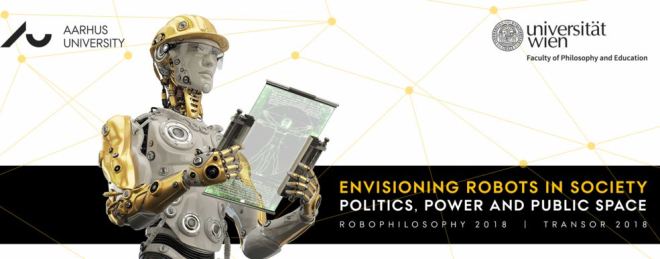
Call for Papers, Posters, Workshops, and Artworks: Robophilosophy 2018

rp

We invite submissions for research contributions that offer discussions of aspects of social robotics written for interdisciplinary research discussion, from the point of view of one or more (but not limited to) the following disciplines: Philosophy (ontology, philosophy of mind and cognitive science, epistemology and knowledge representation, political philosophy, and philosophy of technology, also in culturally comparative perspective), Anthropology Psychology, Political Science, Law, Economy, Sociology, Cognitive Science, Communication Studies, Linguistics, Interaction Studies Robotics, Computer Science, Engineering Art.

Topical focus for papers, posters, workshops and artworks

  • Socio-political challenges of robotization, e.g., changes in political legimitation, expectable polarizations, etc.
  • Changes in power distributions, e.g., across the political, economic, and financial sector
  • Changes in public spaces due to social robotics, e.g., changes in social interaction patterns due to design and functionalities of robots
  • Socio-cultural and socio-political challenges due to massive job loss, e.g., increase of the precariat, new conceptions of work and social recognition
  • Changes in working conditions and employment formats, e.g, types of human-robot ensembles
  • Robots and ethics, e.g. with focus on new formats of “responsible robotics” as R&D paradigm, or new responsibility attributions when robots attain the status of “electronic persons responsible for making good any damage they may cause” (cf. Resolution 20170210IPR61808 of the European Parliament).
  • Re-education and new educations to cope with changes in the workplace, including educational technology
  • Methods of policy making, e.g., the role of the Humanities for research-based policy proposals, necessary changes in the self-conception and research methods of the Humanities
  • Children and robots, robots and the elderly, with focus on socio-cultural values
  • Intercultural philosophy of robotics
  • Conceptual tools for academia-policy dialogue and interdisciplinary research, e.g., analytical and hermeneutic categories from social ontology, epistemology, metaphysics, or ethics redefined for concrete application.

Submission of Abstracts for Research Papers

We invite extended abstracts with references (min. 1000 words, max. 2000 words, excluding references) for research papers on the themes listed above.

Deadline: October 31, 2017; please use formating templates and submission link given here.

­­


Submission of Proposals for Workshops and Panels

We invite abstracts for workshops and panels (1000-3000 words, describing topic, format, and speakers). Workshops will take 2-hour to 4-hour slots, depending on the proposal and on availability of slots in the final program. Panels will take two-hour slots and, like the other submitted papers, should directly address the workshop theme. The format for workshops is free.

Deadline: September 15, 2017; please use formating templates and submission link given here.


Submission of Abstracts for Posters and Art Installations/Performances

We invite abstracts (1000 words) for posters and for art installations or performances.

Deadline: October 31, 2017; please use formating templates and submission link given here.

Inaugurated as President of SPT

Proud to have been inaugurated as President of the Society for Philosophy and Technology (SPT) at last week’s SPT Conference The Grammar of Things in Darmstadt (June 14 – 17). Looking forward to serve SPT in this role and excited about what this function will bring during the upcoming years, and motivated by the fact that Shannon Vallor – former president of the SPT – has been doing such an impressively good job on this… the bar has been set high!

(pictures by Peter Rantasa and Janina Loh, thanks to both of them for capturing the moment)


Interview for my inaugural lecture

Clipboard01

In the context of preparations of my inaugural lecture, I have been interviewed for the University of Vienna’s uni:view magazine. The full article can be read here.

I very much look forward to my inaugural lecture on May 10. It takes place at 5 pm on the Faculty’s dies facultatis in the main building’s Großer Festsaal.

(picture taken by Nana Thurner)

New Romantic Cyborgs

Unbenannt

My new book New Romantic Cyborgs: Romanticism, Information Technology, and the End of the Machine is available now:

https://mitpress.mit.edu/books/new-romantic-cyborgs


Curators will have Impact – interviewed by Artdependence Magazine

2017_03_interviewmc_samuel-zeller-74983_adapted

I was interviewed by Etienne Verbist from Artdependence Magazine, an international online magazine covering the spheres of classic, modern, and contemporary art.

Full interview including countless references to contemporary artists and curators who work on/ with technology to be read here.

Picture provided by Samuel Zeller via Unsplash (licensed under CCO 1.0)

Presentation of upcoming book at CSTMS, Berkeley

mit_pressExcited about today’s talk at the STS Working Group, Center for Science, Technology, Medicine and Society, University of California, Berkeley:

Romantic Cyborgs: Romanticism, Information Technology, and the End of the Machine

Details: here.

For more information on the upcoming book visit MIT Press.

CfP: Workshop “Wittgenstein and Philosophy of Technology”

2017_03_christiaantonnis_wittgenstein_flickr

Picture Source: *

CFP
WORKSHOP
“WITTGENSTEIN AND PHILOSOPHY OF TECHNOLOGY”

DATE 13 March 2017
VENUE TBA, Vienna, Austria

KEYNOTE SPEAKERS
Langdon Winner
Department of Science and Technology Studies, Rensselaer Polytechnic Institute, Troy, NY, USA

Alfred Nordmann
Institute of Philosophy, TU Darmstadt, Germany

Call for Papers: Download

INTRODUCTION TO THE THEME
Few philosophers of technology enlist Wittgenstein’s work when thinking about technology, and scholars of Wittgenstein pay scant attention to remarks about technology in his work. This double neglect of (aspects of) Wittgenstein’s work is symptomatic of a more general gap between philosophy of language and philosophy of technology. This workshop aims to close these gaps with presentations and discussions that use Wittgenstein to conceptually develop existing investigations in philosophy of technology and/or to better understand and evaluate technologies in the 21st century.

Questions to be discussed will include, but are in no way limited to, the following:

1) Is Ludwig Wittgenstein a “forgotten” classical author in the philosophy of technology? Can we read Wittgenstein’s works in a way that renders these works helpful to the philosophy of technology?
2) Conversely, could current positions and concepts in the philosophy of technology furnish a criticism of Wittgenstein’s thought, a criticism perhaps underdeveloped in or absent from the established reception (positive or critical) of Wittgenstein’s works?
3) Can Wittgenstein’s late reflections on use and forms of life add to, possibly even recitfy, current understandings of these notions in the philosophy of technology?
4) What light, if any, does Wittgenstein’s personal engagement with the engineering profession (from his studies in Manchester to his Vienna forays into building technology) shed on his subsequent engagements with philosophy?
5) What can we learn from Wittgenstein to better understand how we talk to machines and how machines talk to us (e.g. social robots)?
6) How can we use Wittgenstein to better understand the cultural, social, and political dimensions of contemporary technosciences such as synthetic biology (e.g. usage of the word “life”)?
7) Does Wittgenstein help us to understand connections between language and technology in the internet of things?
8) Can a Wittgensteinian approach contribute to addressing the problem of how to communicate specialized disciplinary terminology in transdisciplinary research?

CALL FOR PAPERS
A limited number of slots is available for non-invited papers.
Please send a 500 words abstract by 1 February 2017 to agnes.buchberger [at] univie.ac.at if you want to be considered for inclusion in the workshop.

REGISTRATION
Registration to attend is free but obligatory.
For registration and organizational issues contact Agnes Buchberger (agnes.buchberger [at] univie.ac.at)

ORGANISATION

Prof. Mark Coeckelbergh
mark.coeckelbergh@univie.ac.at
http://www.coeckelbergh.wordpress.com/

Michael Funk
funkmichael@posteo.de
www.funkmichael.com

  • University of Colorado, Colorado Springs, USA

Dr. Stefan Koller
skoller@uccs.edu

This workshop is funded by the Chair of Philosophy of Media and Technology (Univ.-Prof. Dr. Mark Coeckelbergh), the Department of Philosophy, and the Faculty of Philosophy and Education, University of Vienna.


* Picture source: Christiaan Tonnis via Flickr Creative Commons (CC BY-SA 2.0)