Appointed as member of European Commision’s High Level Expert Group on Artificial Intelligence

Press release University of Vienna: https://philtech.univie.ac.at/news/news-about-publicatons-etc/news/mark-coeckelbergh-appointed-member-of-eu-high-level-expert-group-on-ai/?tx_news_pi1%5Bcontroller%5D=News&tx_news_pi1%5Baction%5D=detail&cHash=30b05a6f526072c3a3d19e38576780cb

More information on the High Level Expert Group: https://ec.europa.eu/digital-single-market/en/high-level-group-artificial-intelligence

Country Europe Flag Star Eu Eu Flag Europe Flag

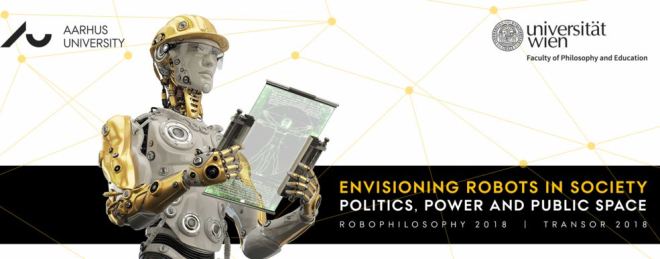
This was Robophilosophy 2018

robo2018_bannerbig

From February 14-17, Vienna hosted the international, transdisciplinary research conference Robophilosophy 2018 as a part of the biennial Robophilosophy Conference Series.

More than 200 participants gathered at the Campus of the University of Vienna to share and discuss their views on social robotics, policies regarding robotics and automation, machine ethics, and several topics more.

It was truly an honor to organize this conference with my team and our co-organizers.
I would like to thank all sponsors, (co-)organizers, and the conference staff for their dedicated support. Also, I want to thank our participants and speakers for joining us in Vienna on this special occasion.

Another thank you goes out to the press representatives, who have spread the word on this important topic to the public. Details on media coverage will soon be available under Media Coverage Robophilosophy 2018 on my website, and on the official conference website.

Robophilosophy 2018
Februray 14-17, Campus der Universität Wien, Spitalgasse 2, 1090 Vienna

Main Organizers of Robophilosophy 2018:
Mark Coeckelbergh, Janina Loh, and Michael Funk
Chair of Media and Technology, University of Vienna

Organizers of the Robophilosophy Conference Series and Co-Organizers RP2018:
Johanna Seibt, and Marco Nørskov, Research Unit for Robophilosophy, Aarhus University see also Research Network TRANSOR 

Funding was provided by the Carlsberg Foundation, the Austrian Ministry for Transport, Innovation and Technology, the Faculty of Philosophy and Education, University of Vienna, the Danish Council for Independent Research, and the Vienna Convention Bureau.

Keynote Speakers
Oliver Bendel
Joanna Bryson
Raja Chatila
Juha Heikkilä
Hiroshi Ishiguro
Catelijne Muller
Simon Penny
Guy Standing
Robert Trappl

More information on the program, individual sessions and workshops can be found on the official website.

Finalist of the 2017 World Technology Awards

finalist

I have been selected as finalist in the category Ethics for the 2017 World Technology Awards.

It is a great pleasure to be therefore considered a Fellow of the World Technology Network (WTN) – a peer-elected community of innovative organizations and individuals working in science, technology and related fields around the world.

Talk at UNESCO lunch debate on ethics of robots

Robots : ethical or unethical
Photo (c) Philip Provily

I have been invited to give a talk on the ethical dilemmas of robotics at the lunch debate Robots: ethical or unethical? at UNESCO, Paris, France on November 10, 2017.

Find more information on the event here.

Also, UNESCO gives an overview of their endeavors in this field here.


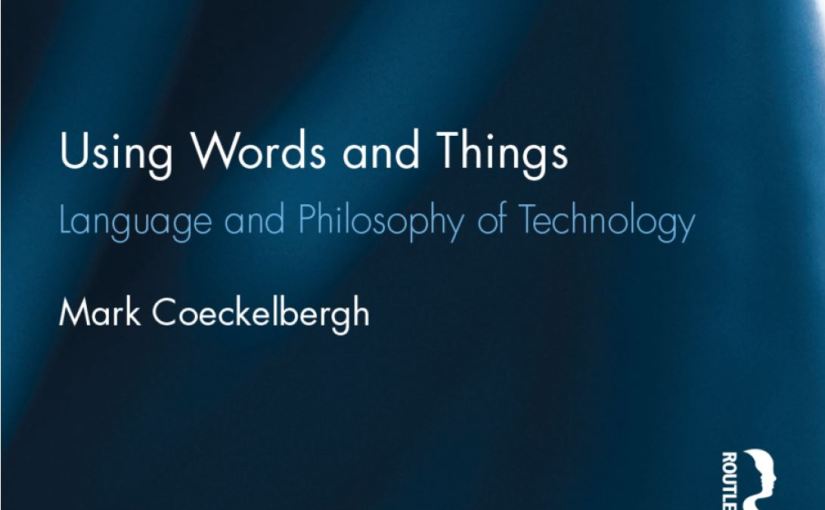
Using Words and Things

Very happy to let you know that my new book on language and technology is out now with Routledge:

UsingWordsAndThings

Published by Routledge, see here: http://bit.ly/2sQ877Q

Content. This book offers a systematic framework for thinking about the relationship between language and technology and an argument for interweaving thinking about technology with thinking about language. The main claim of philosophy of technology—that technologies are not mere tools and artefacts not mere things, but crucially and significantly shape what we perceive, do, and are—is re-thought in a way that accounts for the role of language in human technological experiences and practices. Engaging with work by Wittgenstein, Heidegger, McLuhan, Searle, Ihde, Latour, Ricoeur, and many others, the author critically responds to, and constructs a synthesis of, three “extreme”, idealtype, untenable positions: (1) only humans speak and neither language nor technologies speak, (2) only language speaks and neither humans nor technologies speak, and (3) only technology speaks and neither humans nor language speak. The construction of this synthesis goes hand in hand with a narrative about subjects and objects that become entangled and constitute one another. Using Words and Things thus draws in central discussions from other subdisciplines in philosophy, such as philosophy of language, epistemology, and metaphysics, to offer an original theory of the relationship between language and (philosophy of) technology centered on use, performance, and narrative, and taking a transcendental turn.


New Book: Using Words and Things

With promo code: Product Flyer

Very happy to let you know that my new book on language and technology is out now with Routledge:

20429711_10155628870351133_1664738120194145907_n

Published by Routledge, see here: http://bit.ly/2sQ877Q

Content. This book offers a systematic framework for thinking about the relationship between language and technology and an argument for interweaving thinking about technology with thinking about language. The main claim of philosophy of technology—that technologies are not mere tools and artefacts not mere things, but crucially and significantly shape what we perceive, do, and are—is re-thought in a way that accounts for the role of language in human technological experiences and practices. Engaging with work by Wittgenstein, Heidegger, McLuhan, Searle, Ihde, Latour, Ricoeur, and many others, the author critically responds to, and constructs a synthesis of, three “extreme”, idealtype, untenable positions: (1) only humans speak and neither language nor technologies speak, (2) only language speaks and neither humans nor technologies speak, and (3) only technology speaks and neither humans nor language speak. The construction of this synthesis goes hand in hand with a narrative about subjects and objects that become entangled and constitute one another. Using Words and Things thus draws in central discussions from other subdisciplines in philosophy, such as philosophy of language, epistemology, and metaphysics, to offer an original theory of the relationship between language and (philosophy of) technology centered on use, performance, and narrative, and taking a transcendental turn.


Call for Papers, Posters, Workshops, and Artworks: Robophilosophy 2018

rp

We invite submissions for research contributions that offer discussions of aspects of social robotics written for interdisciplinary research discussion, from the point of view of one or more (but not limited to) the following disciplines: Philosophy (ontology, philosophy of mind and cognitive science, epistemology and knowledge representation, political philosophy, and philosophy of technology, also in culturally comparative perspective), Anthropology Psychology, Political Science, Law, Economy, Sociology, Cognitive Science, Communication Studies, Linguistics, Interaction Studies Robotics, Computer Science, Engineering Art.

Topical focus for papers, posters, workshops and artworks

  • Socio-political challenges of robotization, e.g., changes in political legimitation, expectable polarizations, etc.
  • Changes in power distributions, e.g., across the political, economic, and financial sector
  • Changes in public spaces due to social robotics, e.g., changes in social interaction patterns due to design and functionalities of robots
  • Socio-cultural and socio-political challenges due to massive job loss, e.g., increase of the precariat, new conceptions of work and social recognition
  • Changes in working conditions and employment formats, e.g, types of human-robot ensembles
  • Robots and ethics, e.g. with focus on new formats of “responsible robotics” as R&D paradigm, or new responsibility attributions when robots attain the status of “electronic persons responsible for making good any damage they may cause” (cf. Resolution 20170210IPR61808 of the European Parliament).
  • Re-education and new educations to cope with changes in the workplace, including educational technology
  • Methods of policy making, e.g., the role of the Humanities for research-based policy proposals, necessary changes in the self-conception and research methods of the Humanities
  • Children and robots, robots and the elderly, with focus on socio-cultural values
  • Intercultural philosophy of robotics
  • Conceptual tools for academia-policy dialogue and interdisciplinary research, e.g., analytical and hermeneutic categories from social ontology, epistemology, metaphysics, or ethics redefined for concrete application.

Submission of Abstracts for Research Papers

We invite extended abstracts with references (min. 1000 words, max. 2000 words, excluding references) for research papers on the themes listed above.

Deadline: October 31, 2017; please use formating templates and submission link given here.

­­


Submission of Proposals for Workshops and Panels

We invite abstracts for workshops and panels (1000-3000 words, describing topic, format, and speakers). Workshops will take 2-hour to 4-hour slots, depending on the proposal and on availability of slots in the final program. Panels will take two-hour slots and, like the other submitted papers, should directly address the workshop theme. The format for workshops is free.

Deadline: September 15, 2017; please use formating templates and submission link given here.


Submission of Abstracts for Posters and Art Installations/Performances

We invite abstracts (1000 words) for posters and for art installations or performances.

Deadline: October 31, 2017; please use formating templates and submission link given here.

Inaugurated as President of SPT

Proud to have been inaugurated as President of the Society for Philosophy and Technology (SPT) at last week’s SPT Conference The Grammar of Things in Darmstadt (June 14 – 17). Looking forward to serve SPT in this role and excited about what this function will bring during the upcoming years, and motivated by the fact that Shannon Vallor – former president of the SPT – has been doing such an impressively good job on this… the bar has been set high!

(pictures by Peter Rantasa and Janina Loh, thanks to both of them for capturing the moment)